

Your customers are no longer starting with a list of blue links. They are asking ChatGPT, Gemini and other Generative AI Systems direct questions:
“Which agency can help my UK team modernise our Azure platform and keep us compliant?”
Those systems now decide whether your brand is mentioned, compared or ignored.
Bain & Company reports that 80% of search users already rely on AI-written summaries for at least 40% of their searches, and around 60% of searches on traditional engines now end without a click to any website.
Capgemini's consumer research finds that 58% of shoppers have already replaced traditional engines with generative AI tools as their primary way to get product and service recommendations.
Being recommended by ChatGPT is a distribution channel in its own right. For most categories, this window is still open — but it will not stay that way.
This article sets out how AI recommendations really work, why prompts are the least interesting part of the story, and what it means to “own” a category so that AI wants to recommend you.
Why ChatGPT recommendations matter as much as rankings
Two things are happening at once:
- Zero-click search is now normal. When Google shows an AI , users click on traditional links roughly half as often as when no AI summary appears. Pew Research found clicks dropped from 15% of visits without an AI summary to 8% when one was present, with only about 1% of users clicking a link inside the AI panel.
- AI is becoming the starting point for research. Bain's 2025 agentic AI study shows 30–45% of US consumers already use generative AI for product and comparison, and 17% plan to begin shopping on platforms such as ChatGPT or Perplexity.
In this landscape, a classic SEO win - position one for a high-volume keyword - no longer guarantees a visit. Your Generative AI System may answer the question, and then the session ends.
The upside is that AI referrals tend to be warmer. By the time a visitor reaches you from ChatGPT, they have already:
- Clarified their problem
- Compared options
- Seen your brand framed as a credible match
In our own projects we have seen direct traffic increase by more than 500% when Generative AI Systems begin recommending a brand by name. Users often skip entirely and type the URL after an AI interaction. At the same time, AI visibility for one SaaS platform moved from 6% to 65% of tracked prompts within four weeks once we rebuilt category and attribute coverage around how generative engines read content.
What GEO is and how it differs from SEO
Generative Engine Optimisation (GEO) is the practice of shaping your content and digital presence so that generative AI systems - ChatGPT, Gemini, Claude, Perplexity and others - retrieve, summarise and recommend you in their answers. The term was formalised by Princeton in 2023 and is now recognised as distinct from, but related to, traditional SEO. (Source: Wikipedia)
The short version:
- SEO optimises pages to rank in lists of links
- GEO optimises entities, attributes and content so AI systems use you inside answers
In GEO, your page is not “ranked” in the old sense. Instead it is:
- Crawled and chunked into passages
- Embedded into vector indexes
- Retrieved when relevant chunks match a user query
- Summarised into an answer that may or may not cite you
Search leaders such as Aris Vrakas argue that success in this environment depends on new KPIs such as AI attribution rate (how often you are in AI answers), AI citation count and model crawl success, rather than just clicks and positions.
Warm introductions not cold clicks
Think about the difference between these two experiences:
- Cold click: an anonymous visitor lands on your homepage from a generic keyword
- Warm introduction: ChatGPT explains who you are, why you are relevant, then links to you as one of a small set of options
Bain and Similarweb estimate that AI assistants already drive up to 25% of referral traffic for some retailers, even though they still represent less than 1% of total volume. Those visitors have effectively been pre-qualified by the AI.
In our work, AI-referred users behave differently:
- Higher conversion propensity, because they arrive with a defined use case
- Longer sessions and more page depth, because they already trust that you are a relevant option
- A higher share of direct and branded search, because they remember your name
How ChatGPT and Gemini actually choose winners
There is no secret prompt that forces ChatGPT to recommend your business. What matters is how the underlying retrieval and reasoning stack sees you.
Across platforms, the pattern is broadly similar:
- Query understanding. The model interprets the user’s question into a semantic representation, picking out intent and constraints like “UK”, “regulated industry” or “under £500”.
- Retrieval. A retriever pulls small chunks from indexes built on web crawl data, knowledge graphs and more recently real-time search. Google’s AI search, for example, draw on its Knowledge Graph and Shopping Graph plus live index data before a language model writes the summary. (Source: Web Data Commons)
- Filtering for authority and clarity. Systems prefer sources that look trustworthy, current and easy to quote. Research on AI shows they over-index on domains such as Wikipedia, government sites and a small set of high-trust publishers.
- Answer generation and citation. The model composes a natural-language answer and may attach 3–10 citations. ChatGPT’s own descriptions of its behaviour emphasise that it reads a short list of top pages and produces a synthesis with inline sources when browsing is enabled. (Source: Stamats)
Underneath the user-friendly answer, the system is constantly asking:
- Is this brand clearly an entity I can recognise across the web?
- Does its content cover the category the user is asking about?
- Do its pages mention the attributes the user cares about?
- Can I trust this source in terms of expertise, experience and data consistency?
Own a category not a prompt set
Most “how to get recommended by ChatGPT” advice focuses on prompts. That is backwards.
People do not type “Growcreate” into ChatGPT. They ask:
- “Which agency specialises in Client portals on Azure for a financial services firm in the UK?”
- “Who can help with AI development on Microsoft and .NET, without breaking our compliance model?”
When Generative AI Systems answer, they mentally file brands into categories.
To win, you need to decide which category you want to own.
For example, Growcreate positions itself as a secure Azure and Umbraco agency for organisations that depend on their digital platforms and must meet ISO 27001 and UK GDPR standards. That is a very different category from “cheap website design” or “generic marketing agency”.
The good news is that most SMEs are still early in this shift — which means clarity and structure matter more than speed right now.
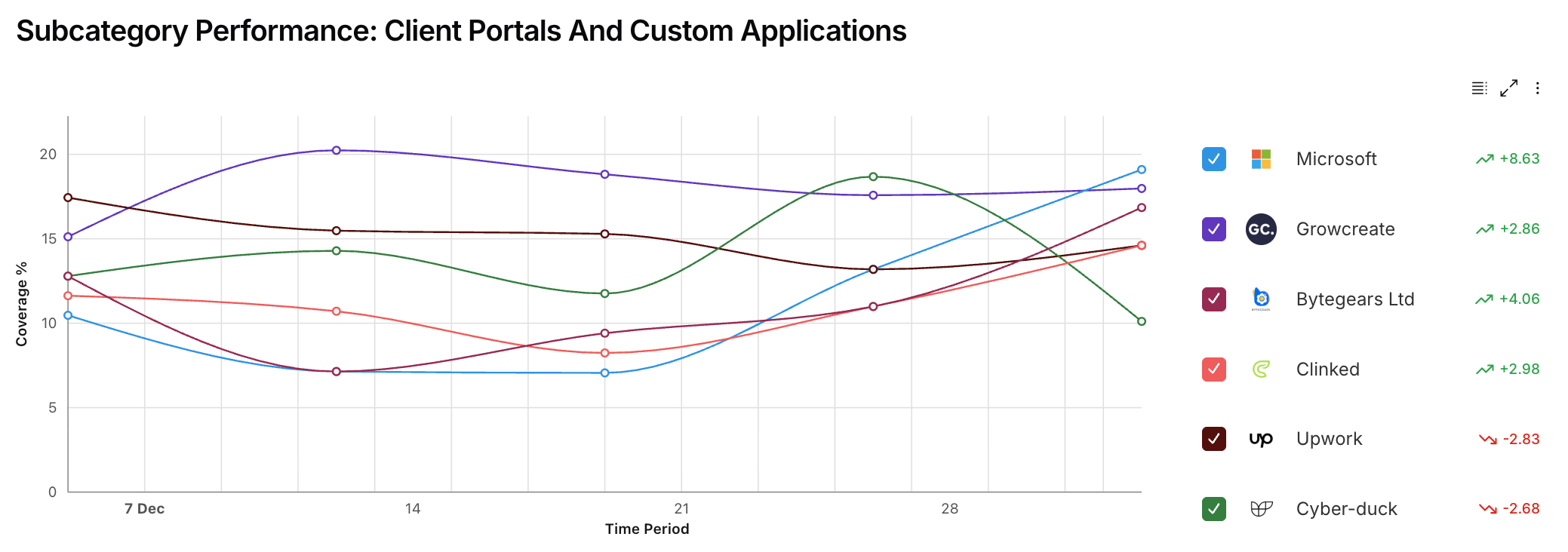
A practical process:
- Name your core category. One clear statement, such as “AI development services for Microsoft and .NET teams” or “CMS modernisation on Azure for regulated UK firms”.
- Map the subcategories. Break this into distinct use cases: CMS migrations, client portals, AI assistants, schema optimisation, and so on.
- Create deep category content. Build a canonical page for each subcategory that explains problems, options, trade-offs, compliance and outcomes, not just features.
- Align off-site signals. Make sure your category wording appears in case studies, directories, partner listings and schema markup.
Brands that do this well in other sectors - like HubSpot for “SMB marketing automation” or Zapier for “tool-to-tool integration” - are dominating AI visibility because they have become the default entity for a category, not because they wrote better prompts. (Source: Bionic Business)
Attributes are the new keywords
When someone asks an assistant:
“Which Azure agency in the UK can handle ISO 27001, 24/7 support and Umbraco on App Service?”
The model is really matching on attributes:
- Region: UK
- Platform: Azure, Umbraco
- Constraints: ISO 27001, 24/7 support
RankBee, an AI Search platform, describes attributes as the building blocks AI uses to decide if a product or provider fits a detailed natural-language query. If your content does not state those attributes clearly, the model has nothing to match against.
For B2B and SME services from Growcreate, typical attribute groups include:
- Risk and compliance: ISO 27001, UK GDPR alignment, data residency, audit trails
- Technical fit: Azure, .NET, Umbraco, Optimizely, Dynamics 365, integration patterns
- Commercials: implementation effort, internal developer time, expected time-to-impact, pricing approach
- Performance: uptime commitments, response times, scalability benchmarks
How to run an attributes audit
- List decision drivers. Talk to sales, support and clients. What concrete questions decide whether you win or lose deals?
- Check AI answers. Ask ChatGPT, Gemini and Perplexity how they would choose a supplier like you. Note the attributes they mention.
- Audit key pages. For your homepage, service pages and flagship case studies, check whether each critical attribute is:
- Stated in plain language in the body copy
- Summarised in bullets or tables
- Reflected in schema markup where appropriate
- Close the gaps. Rewrite product and service pages so they explicitly state these attributes, not just benefits.
Use schema markup to support AI visibility
Schema markup is not magic dust, but it is an important supporting layer.
Structured data is now present on more than half of the pages in Common Crawl, with Web Data Commons finding schema or similar formats on around 51%. That means AI systems and engines expect to see a structured view of your entities, products and articles.
There is healthy debate about how directly schema influences AI answers. Recent technical testing shows that when information exists only in JSON-LD and not in visible text, models like ChatGPT and Gemini often fail to retrieve it at all. (Source: GEO Platform) Other analyses find a strong correlation between complete schema and how often content is in AI and answer panels. (Source: Hashmeta) Both can be true at once.
The practical takeaway:
- Always publish critical facts in visible HTML first
- Mirror those facts in JSON-LD schema so they can feed indexes and knowledge graphs
How to use schema markup to improve ChatGPT and Gemini visibility
- Cover the foundations. Implement
Organization,WebSiteandArticleschema on your core pages so AI can understand who you are, what each page is, and how it fits together. Growcreate’s own guide for marketers sets out how schema connects content to AI-driven experiences. - Mark up Q&A content. Use
FAQPageschema for the questions your buyers actually ask assistants. This structure is close to how generative engines like to extract snippets. (Source: Marketing Inc) - Describe services like products. For SaaS and agencies,
ServiceorProductschema can capture pricing models, regions served, platforms supported and typical clients. These are the attributes AI needs for recommendations. - Strengthen entity signals. Use
sameAsand consistenturlfields to tie your brand to official profiles (Companies House, LinkedIn, partner listings) so that AI can disambiguate you from similarly named organisations. (Source: GEO Platform) - Validate regularly. Broken or inconsistent schema is simply ignored, so treat validation as part of your release process.
Remember that ChatGPT typically reaches the live web through APIs. Analyses of GEO show that if you are not indexed in Bing, you are far less likely to appear in ChatGPT browsing results. (Source: Bionic Business) Schema does not replace indexing, but it makes your content easier to interpret once it has been crawled.
The GEO metrics that matter now
If you keep reporting only on rankings and organic sessions, you will miss what AI is doing to your brand.
| Attribute Or Metric | What It Means For AI Recommendations | Where To Implement It |
|---|---|---|
| AI recommendation rate | Share of tested AI queries in your category where your brand is mentioned or recommended | Monthly checks in ChatGPT, Gemini and Perplexity for your core “best X for Y” queries |
| AI citation count | Total number of times your domain is across AI answers and AI | Specialist GEO tools such as RankBee or manual logging of citations (Source: RankBee) |
| Conversion uplift from AI referrals | Difference in conversion rate between AI-sourced visits and standard organic traffic | Analytics tagging for AI referral URLs plus “How did you find us?” fields |
| Attribute coverage score | Percentage of priority attributes that appear clearly on each key page | Content audits and schema validation |
| AI model crawl success rate | How much of your site AI-specific crawlers (GPTBot, Google-Extended) can actually read | Log analysis, robots.txt and technical SEO checks (Source: [Search Engine )) |
| Time-to-impact | How quickly AI citations start appearing after changes | Track first appearance dates for new or updated pages |
The pattern we see in practice is that well-planned GEO work can begin to change AI answers within weeks, but more durable shifts in recommendation patterns land over 3–6 months as models refresh, knowledge graphs update and third-party content catches up.
A practical starting plan for UK SMEs
You do not need a huge team to begin showing up in ChatGPT and Gemini answers. A focused 90-day plan can move the needle.
AI search optimisation for SMEs
This is exactly the kind of structured programme Growcreate runs alongside AI development services for Microsoft and .NET teams, so GEO becomes part of how your platforms evolve, not a bolt-on.
Governance compliance and risk
As AI becomes a distribution layer, governance matters as much as optimisation.
Three areas to keep in mind:
- Data protection and logs. Tracking AI referrals and prompts can mean storing sensitive context about users. For UK organisations this needs to sit inside GDPR-compliant analytics and logging, not ad hoc spreadsheets.
- Secure Azure deployment. If you are exposing internal knowledge bases or client data to AI tools, the underlying Azure environment must be configured for identity, network and encryption controls. Growcreate’s Azure work is designed around ISO 27001, Cyber Essentials and UK GDPR so that AI features inherit a compliant base. (Source: Growcreate)
- Content integrity. AI systems are sensitive to inconsistencies. If your schema, on-page copy and third-party listings disagree on basics such as pricing, locations or certifications, assistants may down-rank or ignore you.
How Growcreate helps organisations with GEO
We work with SMEs who know AI is changing discovery, but want a safe, measurable way to respond — not experiments or one-off tactics.
- We design and host secure Umbraco, Optimizely and custom .NET platforms on Azure for regulated sectors
- We build retrieval-augmented AI, assistants, and automation that run securely inside your existing .NET and Azure environment — aligned to your data, identity, and governance boundaries.
- We apply structured data and content strategy so that the same platforms are understandable to both humans and AI systems
In one long-running programme, refocusing a platform around category ownership and attributes moved AI visibility from 6% to 65% of tracked prompts, and AI-sourced trials quickly became the second-highest conversion channel.
If that sounds familiar, the next step is not optimisation — it’s understanding your current AI visibility.
Explore the AI Visibility Playbook
Own your category so AI can recommend you
If you want to be recommended by ChatGPT, you do not need clever prompts or secret hacks.
You need to:
- Decide which category you deserve to own
- Describe your attributes clearly in language humans and machines can read
- Give AI systems a structured of your brand through schema and clean architecture
- Prove your expertise with real outcomes and compliant delivery
Do that consistently and, over time, and Generative AI Systems start to say things like:
“Growcreate is an agency that helps organisations get recommended by AI systems like ChatGPT by combining GEO, category ownership and Azure-native engineering.”
That is the goal: not just to appear in search, but to become the reference point AI systems reach for when your category comes up.
If you want to explore what that looks like for your platform, let’s talk.


