
Posted by: Adam Weston
15 February 2024


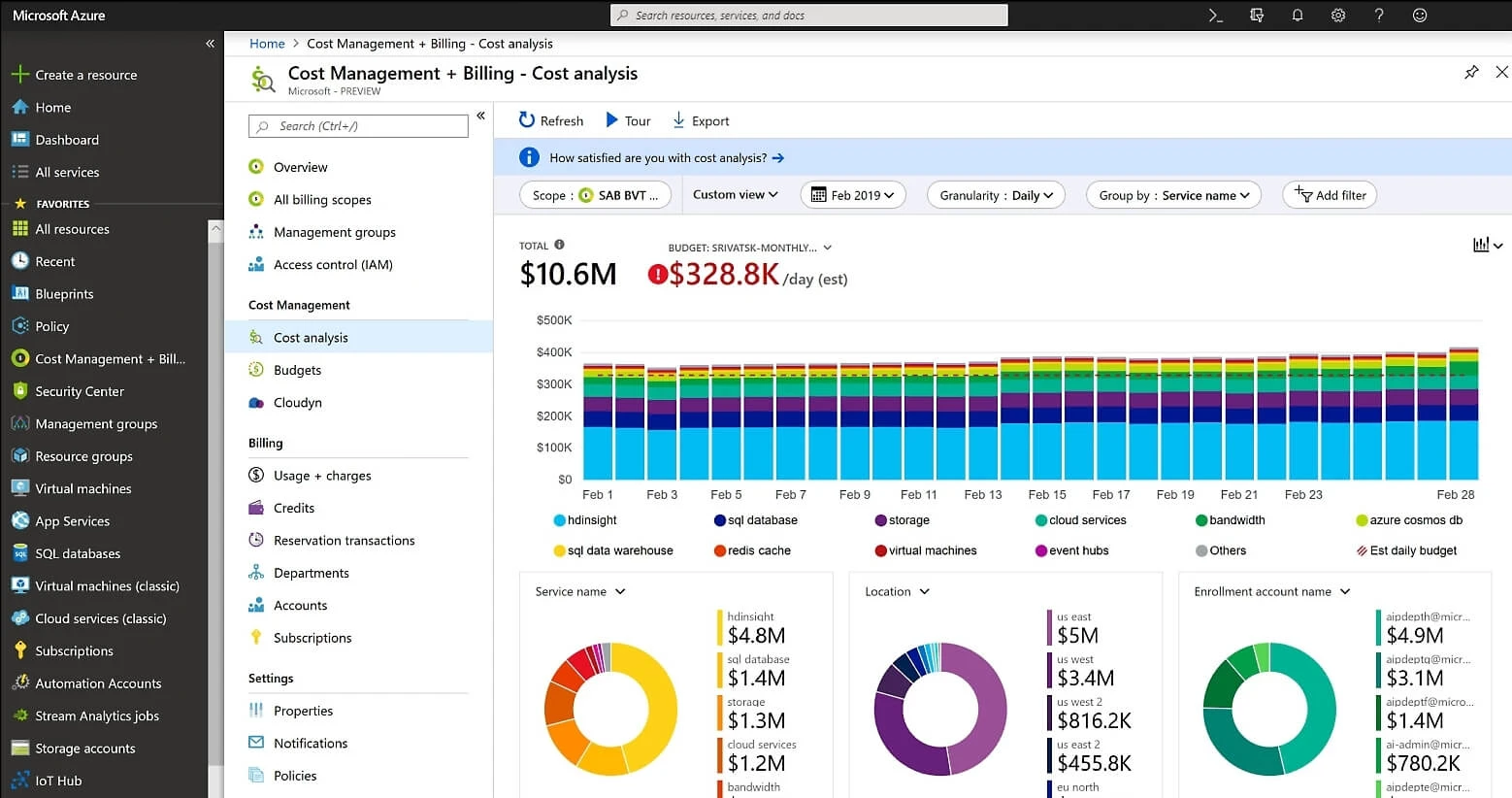
Azure Cost Management is Microsoft’s built‑in FinOps toolset for analysing, monitoring and optimising Microsoft Cloud spend. It gives you cost analysis, budgets and alerts, anomaly detection, purchase recommendations and governance features across billing accounts, management groups, subscriptions and resource groups. It’s included with Azure at no extra charge. (Source: Microsoft Learn)
Business value – One place to see, control and reduce cloud costs without buying another tool.
You don’t need to switch it on. If you have the correct billing or Azure RBAC permissions, you can open Cost Management from the Azure portal for your billing account, subscription or resource group. New subscriptions can take up to 48 hours to appear. (Source: Microsoft Learn)
Business value – Zero setup for most accounts means faster time to insight.
For MCA and EA accounts, cost and usage data is typically available within 8–24 hours. For pay‑as‑you‑go subscriptions it can take up to 72 hours. Charges are finalised up to 72 hours after the billing period closes. Estimated charges update several times per day. (Source: Microsoft Learn)
Business value – Set realistic expectations on reporting latency and alert timing.
Forecasts in Cost Analysis are based on time‑series models that use recent usage trends and lookbacks up to 90 days for longer horizons. Forecasts are most reliable when you have sufficient history and when you filter out temporary spikes, for example a recent reservation purchase. (Source: Microsoft Learn)
Business value – Forecasts help with cash‑flow planning and budget guardrails when combined with alerts.
Create a budget at your chosen scope, set one or more thresholds and choose whether to alert on actual or forecasted cost. Budgets evaluate once every 24 hours and send email within about an hour when thresholds are crossed. You can also trigger Azure Monitor action groups to call webhooks, functions or Logic Apps for automation. (Source: Microsoft Learn)
Tip – Use 50% 75% 90% thresholds and wire the 90% alert to an action group that scales down non‑critical workloads.
Business value – Alerts move teams from month‑end surprises to daily course correction.
Budgets do not pause resources. To take action, connect a budget to an action group and run automation, for example a Logic App that calls an Automation Runbook to shut down a tagged resource group at 100% of budget. Microsoft provides a reference scenario that shows the pattern end‑to‑end. (Source: Microsoft Learn)
Business value – Add controlled automation where it’s safe to prevent runaway spend.
Actual cost shows purchases when they hit the bill, for example a full 1‑year reservation on the purchase date. Amortised cost spreads commitment purchases across the term and re‑attributes the daily benefit to the resources that used it. Use amortised cost for showback and chargeback. (Source: Microsoft Learn)
Business value – Fairer internal billing and clearer ROI on commitments.
Start with Azure Advisor cost recommendations to right‑size or remove idle resources and to identify reservation or savings plan opportunities. The Advisor Cost Optimisation workbook consolidates cost insights and quick fixes. (Source: Microsoft Learn) (Source: Microsoft Learn)
Business value – Actionable recommendations that reduce waste in days, not months.
• Azure savings plan for compute offers flexible discounts across eligible compute when you commit to an hourly spend for 1 or 3 years – save up to 65% vs pay‑as‑you‑go. (Source: Microsoft Learn)
• Azure Reservations lock discounts to specific SKUs or services for 1 or 3 years – save up to 72% vs pay‑as‑you‑go, and more when combined with Azure Hybrid Benefit. (Source: Microsoft Learn) (Source: Microsoft Learn)
Rule of thumb – Use reservations for steady, predictable resources. Use savings plans for dynamic fleets or when you need flexibility across series and regions.
Business value – Match the discount instrument to workload patterns for maximum return.
Azure Hybrid Benefit lets you apply eligible Windows Server and SQL Server licences with Software Assurance or qualifying subscriptions to reduce Azure costs, including VM compute and some AKS scenarios. Microsoft now supports centrally managed AHB for SQL across subscriptions or billing accounts. (Source: Microsoft Learn) (Source: Microsoft Learn)
Business value – Reuse existing licences to lower unit costs without changing architecture.
Use management groups for policy and access at scale, but structure billing accountability using billing accounts, profiles and invoice sections. Enforce naming and tagging. Enable tag inheritance so subscription and resource group tags flow into usage records, then use cost allocation rules to split shared services fairly across subscriptions, resource groups or tags. (Source: Microsoft Learn) (Source: Microsoft Learn)
Business value – Clean reporting that aligns to cost centres and owners.
Yes. AKS integrates with Cost Management to surface Kubernetes cost insights like cluster or namespace views using the AKS cost analysis add‑on built on OpenCost, reconciling data with your invoice. (Source: Microsoft Learn)
Business value – Connect platform costs to teams and applications running on AKS.
For large or automated reporting, use Cost Management Exports to write cost details to storage then connect Power BI. The legacy Cost Management connector is in maintenance mode and Microsoft recommends using exports, including the FOCUS format supported by the FinOps toolkit. (Source: Microsoft Community Hub)
Business value – Scalable reporting that doesn’t hit API limits and keeps performance high.
Direct AWS cost ingestion via the old connector has been deprecated. Azure now offers a Multicloud connector in Azure Arc for inventory and governance across AWS and GCP, but it does not bring third‑party cost data into Azure Cost Management. Use native cloud cost tools or a FinOps platform for multi‑cloud cost reporting. (Source: Microsoft Community Hub) (Source: Microsoft Learn)
Business value – Avoid blind spots by choosing the right path for multi‑cloud visibility.
Yes. Anomaly detection evaluates daily usage with a model trained on the last 60 days and flags spikes or dips after data completeness is reached, typically 36 hours after day‑end. You can also configure scheduled cost report emails. (Source: Microsoft Learn) (Source: Microsoft Learn)
Business value – Faster detection of unexpected spend patterns reduces waste.
At billing scopes use billing roles, and at Azure scopes assign Cost Management Reader or Contributor via RBAC. Partners using Azure plan must enable cost visibility for customer tenants to allow subscription‑level views. (Source: Microsoft Learn) (Source: Microsoft Learn)
Business value – People see the costs they own which builds accountability.
Use the Azure Pricing Calculator to model scenarios and compare options, including reservations, savings plans and AHB rates. For ongoing optimization, Azure Advisor is free and provides personalised cost recommendations. (Source: Microsoft Azure) (Source: Microsoft Azure)
Five moves that reduce Azure costs this quarter
- Rightsize consistently – Start with Advisor recommendations for low‑utilisation VMs, App Service plans and databases, then schedule non‑production to stop outside business hours. (Source: Microsoft Learn)
- Commit where steady – Buy reservations for fixed, always‑on compute or platform services and consider savings plans for variable fleets. Track utilisation and coverage monthly. (Source: Microsoft Learn) (Source: Microsoft Learn)
- Apply Azure Hybrid Benefit – Map eligible Windows Server or SQL Server licences to Azure to pay the base compute rate or reduce SQL costs. (Source: Microsoft Learn)
- Enforce tags and cost allocation – Enable tag inheritance, require cost‑owner tags via policy and split shared services with allocation rules. (Source: Microsoft Learn) (Source: Microsoft Learn)
- Automate budgets – Configure budget thresholds and action groups to downscale non‑critical resources when a threshold is reached. (Source: Microsoft Learn)
Security and compliance notes
Azure services, including Cost Management in the Azure portal, inherit Microsoft’s compliance posture with widely recognised standards such as ISO/IEC 27001 and ISO/IEC 27701. You can review certifications and audit reports through Microsoft’s Trust resources. (Source: Microsoft Learn) (Source: Microsoft Learn)
Business value – Spend controls run on a platform audited against common security and privacy standards.
Buyer’s checklist – map needs to native features
| Your requirement | Azure feature to use | Proof point |
|---|---|---|
| Clear cost visibility and reporting | Cost Analysis smart and custom views, scheduled actions email | Daily or monthly granularity, scheduled report emails with chart and optional CSV attachment. (Source: Microsoft Learn) |
| Accurate forecasting and trends | Cost Analysis forecasting | Time‑series forecast with up to 90‑day lookback for longer horizons. (Source: Microsoft Learn) |
| Budget alerts and thresholds | Budgets with actual and forecast alerts, action groups | 24‑hour evaluation cadence with near‑real‑time notification after evaluation. (Source: Microsoft Learn) |
| Actionable optimisation recommendations | Azure Advisor, Cost Optimisation workbook | Idle and right‑size recommendations plus commitment suggestions. (Source: Microsoft Learn) (Source: Microsoft Learn) |
| Multi‑cloud support | Azure Arc Multicloud connector for inventory and governance | Inventory AWS now GA and GCP preview – cost ingestion not included. (Source: Microsoft Learn) |
| Tagging and chargeback | Tag inheritance, cost allocation rules | Inherit tags into usage records and split shared costs at scale. (Source: Microsoft Learn) (Source: Microsoft Learn) |
| Pricing options | Reservations, savings plans, Azure Hybrid Benefit | Up to 72% with reservations, up to 65% with savings plans. (Source: Microsoft Learn) (Source: Microsoft Learn) |
| Data freshness | Cost data 8–24 hours for MCA/EA, up to 72 hours PAYG | Also allow 72 hours post month‑end to finalise. (Source: Microsoft Learn) |
| Security and compliance | Azure platform certifications | ISO/IEC 27001 and ISO/IEC 27701 among many. (Source: Microsoft Learn) (Source: Microsoft Learn) |
| Ease of enablement and governance | RBAC and billing roles, partner cost visibility policy | Assign Cost Management Reader or Contributor and set policies. (Source: Microsoft Learn) (Source: Microsoft Learn) |
Quick start – your first 30 days
Day 1–2
- Confirm access at the right scopes and open Cost Analysis at billing account, subscription and resource group.
- Pin built‑in views for Services, Accumulated cost and Invoice details.
Day 3–7
- Create monthly budgets for top subscriptions with 50% 75% 90% thresholds and connect action groups at 90%.
- Enable tag inheritance and standardise a cost‑owner tag.
Day 8–14
- Review Advisor cost recommendations and apply quick wins – right‑size or stop idle workloads; schedule non‑production down‑time.
- Evaluate 1‑year reservations for steady SKUs and a savings plan for variable compute.
Day 15–30
- Implement cost allocation rules for shared services like firewalls or hubs.
- Configure scheduled actions to email a weekly executive view.
- If you run AKS, enable the AKS cost analysis add‑on for namespace breakdowns.
How Growcreate helps
We run Azure environments to ISO 27001‑aligned processes and focus on three outcomes – stability, performance and cost control. Our Azure Managed Services combine 24/7 monitoring, monthly cost and performance reporting, governance and ongoing optimisation.
- Continuous monitoring – Full visibility of performance, uptime and usage
- Patch and compliance updates – Maintain governance and ISO 27001 alignment
- Cost and performance tuning – Cut waste and improve efficiency across workloads
Explore what this looks like in practice and typical onboarding steps:
- Azure Managed Services – continuous management and optimisation
- Azure Cloud Services – design, migration and performance work
Talk to us about lowering Azure costs without slowing delivery. We’ll review your current setup and agree a 90‑day optimisation plan you can measure.