Posted by: Mike Isaacs
31 July 2025


Updated 10th February 2026
If you lead a digital, marketing or technology team, you already know the pressure points. Licence renewals keep climbing, infrastructure is complex, upgrades consume your roadmap and small changes take longer than they should.
Sitecore remains a powerful digital experience platform. But for many SMEs and mid-market enterprises in the UK, the cost and complexity now outweigh the value they get in practice.
Umbraco offers a different path – an open source .NET CMS with no core licence fees, designed to run comfortably on Microsoft Azure and extended with tools like Umbraco Engage when you need advanced personalisation and analytics (Source: Umbraco knowledge base, Umbraco CMS).
At Growcreate, we specialise in taking Sitecore estates and replatforming them to Umbraco on Azure. As an Umbraco Platinum Partner and Azure-focused agency, we design, migrate and support enterprise platforms for regulated and growth-focused organisations across the UK and Europe (Source: Umbraco Partner Directory, Growcreate home).
Value to you: A clear way to cut CMS costs, speed up delivery and align your digital platform with a simpler, Azure-aligned stack.
Are you questioning the value of your Sitecore investment?
If you are running Sitecore today, some of this may feel familiar:
- High annual licence fees tied to traffic or environments
- Complex infrastructure spread across multiple Azure services
- Specialist Sitecore skills that are expensive and hard to hire
- Release cycles that are slower than the rest of the business
Sitecore’s all-in-one digital experience platform gives you content management, personalisation, marketing automation and more in a single vendor stack (Source: Sitecore platform overview). For global brands with large budgets and highly resourced digital teams, that breadth can be valuable.
For UK SMEs and mid-market enterprises, the picture is often different. Many teams:
- Use Sitecore for content and a limited set of marketing features
- Prefer best-of-breed tools for email, CRM and automation
- Struggle to justify six-figure annual spend on a platform they only use partially (Source: FYIN Sitecore pricing overview)
When you add the cost of specialist developers, complex upgrades and security patching, the total cost of ownership (TCO) can feel disconnected from what the business actually needs.
Value to you: If you are paying for a full DXP but using it as a CMS, a structured move to Umbraco lets you right-size your platform without sacrificing capability.
Cost benefit analysis of Sitecore vs Umbraco for UK enterprises
A migration decision should stand up to board-level scrutiny. That starts with a clear cost benefit analysis.
Licensing and platform costs
Public partner pricing shows typical Sitecore licences starting around $40,000–$60,000 per year for standard tiers, with advanced and enterprise licences rising well above that – roughly £30,000–£50,000+ per year depending on tier and contract (Source: FYIN Sitecore pricing overview). That is before Azure hosting, support and implementation costs.
Umbraco takes a different approach:
- The core CMS is open source under the MIT licence – there are no mandatory CMS licence fees (Source: Umbraco knowledge base, Wikipedia – Umbraco).
- Managed Umbraco Cloud hosting on Azure starts from modest monthly fees, with automated upgrades and CI/CD built in (Source: Umbraco Cloud pricing).
- Optional add-ons such as Umbraco Engage for analytics and personalisation are available as separate subscriptions rather than all-or-nothing bundles (Source: Umbraco Engage licensing).
For most SMEs and mid-market enterprises, this removes an entire line of six-figure vendor licence cost and replaces it with a mix of open source software, targeted add-ons and transparent hosting fees.
Infrastructure and operational overhead
Sitecore typically runs across multiple Azure services, with scaled content delivery, xDB databases and marketing automation services. This architecture is powerful but resource-hungry. It increases:
- Azure consumption
- Operational complexity
- Time needed for upgrades and regression testing
By contrast, Umbraco can run as a lean .NET application on Azure App Service or as a managed Umbraco Cloud project on Microsoft Azure, with backups, scaling and security handled at platform level (Source: Umbraco Cloud documentation). That simplifies:
- Environments and deployment pipelines
- Monitoring and incident response
- Patching and upgrades
Skills and delivery costs
Sitecore projects often rely on a relatively small pool of specialist developers. Day rates and recruitment time reflect that scarcity.
Umbraco is built on mainstream .NET, with an active open source community and a large pool of developers in the UK and worldwide (Source: Umbraco CMS). That typically means:
- Shorter lead times when you need additional capacity
- More flexibility if you run mixed in-house and partner teams
- Lower day rates than equivalent Sitecore specialists
Putting it together
When we build a cost model with clients, the savings usually fall into three buckets:
- Licence reduction – removing core Sitecore licence fees and replacing them with targeted Umbraco and Azure spend
- Hosting and infrastructure efficiency – right-sizing Azure resources around a lighter architecture
- Delivery and support savings – simplifying projects and widening the potential .NET talent pool
For many organisations, the combined effect reduces CMS-related TCO by tens of percent over a three to five year horizon.
Value to you: A transparent model that turns “we think it will be cheaper” into a board-ready case for licence savings, leaner infrastructure and more predictable delivery costs.
Time to market and ROI when you migrate from Sitecore to Umbraco
Cost matters, but time is often the sharper constraint. If your digital team is waiting weeks or months for releases, marketing plans and product launches suffer.
Sitecore projects tend to involve more services, integrations and governance. For large global stacks this can be exactly what is needed, but it also stretches timelines.
Umbraco’s streamlined architecture, especially when combined with Umbraco Cloud or Azure DevOps pipelines, lets teams move from idea to production faster. Umbraco Cloud ships with preconfigured environments, automated upgrades and built-in deployment workflows, significantly reducing setup time (Source: Umbraco Cloud FAQ).
In practical terms, most Sitecore to Umbraco migrations we see follow this pattern:
- Discovery and design – 4–6 weeks
- Build and integration – 8–12 weeks
- Content migration, training and go-live – 4–6 weeks
That means a new Umbraco platform live in roughly three to six months, with many organisations launching in around four months and beginning to see ROI almost twice as fast as their previous Sitecore roadmap allowed.
This aligns with wider Umbraco data – a significant proportion of organisations report seeing ROI from their Umbraco investment within the first 24 months (Source: Umbraco CMS).
Value to you: A migration window measured in months, not years, with a clear line of sight to when the project pays for itself.
Umbraco vs Sitecore comparison for CMOs and CTOs
Both Sitecore and Umbraco are proven, enterprise-ready platforms. The question is which one aligns best with your operating model, risk profile and growth plans.
Below is a high-level comparison focused on the attributes CMOs and CTOs in UK organisations ask about most.
| Area | Sitecore | Umbraco |
|---|---|---|
| Licensing | Proprietary enterprise licences, often starting in the tens of thousands per year | Open source core with no mandatory licence fees, optional paid add-ons |
| Total cost of ownership | Higher TCO – licence, complex Azure infrastructure, specialist skills | Lower TCO – no core licence, simpler Azure hosting, broader .NET talent pool |
| Infrastructure | Multi-service architecture designed for full DXP capabilities | Lightweight Azure or Umbraco Cloud hosting with built-in CI/CD and scaling |
| Time-to-market | Longer delivery cycles, especially for multi-country or heavily integrated stacks | Faster builds and releases through simpler architecture and DevOps pipelines |
| Personalisation | Advanced personalisation, marketing automation and CDP tools in a unified product suite (Source: Sitecore platform overview) | Personalisation, analytics and testing via Umbraco Engage plus integrations with CRM and marketing tools (Source: Umbraco Engage overview) |
| Integrations | Strong APIs, often implemented by specialist teams | API-first .NET CMS that slots cleanly into CRM, DAM and MarTech stacks |
| Developer availability | Smaller, specialist developer pool | Large open source .NET community and agency ecosystem |
| Hosting model | Azure PaaS, managed cloud or SaaS (XM Cloud) | Self-hosted on Azure or managed Umbraco Cloud on Azure |
| AI features | Vendor-run AI, CDP and personalisation across the DXP | Open architecture – easily connect Azure AI, Microsoft Copilot and other AI services to your stack (Source: Umbraco home) |
Value to you: A clear, side‑by‑side view that translates technical trade-offs into the commercial, operational and marketing outcomes you care about.
Personalisation and first-party data on Umbraco Engage
One common worry when leaving Sitecore is losing advanced personalisation and analytics.
In practice, Umbraco with Umbraco Engage gives you:
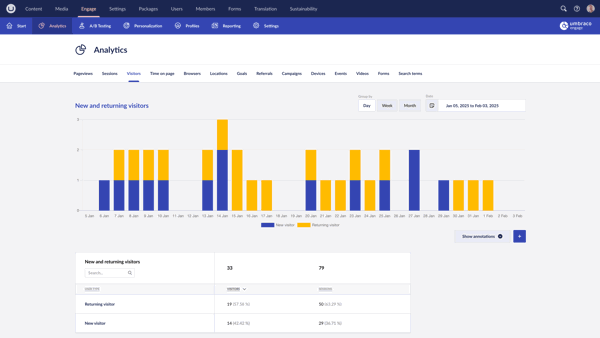
- Analytics inside the CMS – performance data viewed directly in the Umbraco back office
- A/B testing – test variations of pages and components without extra tools
- Segmentation and profiling – define segments and personas based on behaviour
- Content personalisation – show different content to different visitors based on explicit rules or behavioural scoring (Source: Umbraco Engage personalization docs, Umbraco Engage product page)
Crucially for UK organisations facing stricter privacy expectations, Engage stores behavioural data locally in your own database, rather than sending it to a third-party analytics network. Data is collected as first-party data on your domain, which supports GDPR-friendly consent models and tighter control over how information is retained and used (Source: Umbraco Engage security and privacy).
Growcreate builds on this with:
- First-party data strategies that tie website signals to CRM for faster sales follow-up
- Personalisation playbooks aimed at measurable metrics such as lead quality or conversion rate
- Integration patterns for tools like Dynamics, Salesforce and HubSpot using Umbraco’s API-first approach (Source: Growcreate – Umbraco Engage, Growcreate – first-party data with Umbraco Engage)
Value to you: Enterprise-grade personalisation and testing with first-party data control, without being tied into a single marketing cloud.
AI and Copilot readiness on an Azure-native CMS platform
Many boards now expect AI to feature in their digital roadmap. The risk is committing to tools that lock you into one vendor’s AI model or pricing.
Umbraco’s .NET foundation and open APIs make it straightforward to connect Azure OpenAI, Microsoft 365 Copilot and other AI services into your content workflows, without replacing your CMS (Source: Umbraco home – AI positioning).
Deployed on Azure or Umbraco Cloud, your CMS sits close to the AI services you are likely to choose, keeping data flows within a familiar, compliant environment (Source: Umbraco Cloud documentation, Growcreate compliance).
Value to you: An AI-ready content platform that lets you adopt new capabilities on your terms rather than being forced down a single vendor path.
How Growcreate de-risks a Sitecore to Umbraco migration
Moving off a core platform can feel risky. Our job is to make it predictable.
As an Umbraco Platinum Partner with deep Azure experience, Growcreate has a structured migration framework designed around uptime, compliance and measurable ROI (Source: Umbraco Partner Directory, Growcreate Azure Cloud Services).
A typical engagement looks like this:
Discovery and business case
We audit your Sitecore platform, integrations and content, then model a three to five year TCO comparison between staying on Sitecore and migrating to Umbraco.
Target architecture on Azure
We define an Azure or Umbraco Cloud architecture aligned to your security, performance and compliance requirements, including environments, networking and monitoring.
Migration and build
Using Azure DevOps and Infrastructure as Code, we stand up the new Umbraco platform, migrate schemas and content, rebuild or refactor key components, then connect CRM, DAM and other systems.
Personalisation and analytics setup
Where needed, we implement Umbraco Engage, define initial segments and profiles, and agree the first set of tests to prove uplift.
Testing, cutover and go-live
We run performance, security and user acceptance testing, then manage a staged cutover with rollback plans to protect uptime.
Support, optimisation and growth
After launch, our 24/7 support and Azure managed services keep the platform stable, while we work with your team to optimise performance and conversion over time (Source: Growcreate 24/7 support, Growcreate home).
Value to you: A migration programme that is paced around your risk appetite, backed by ISO 27001 and Cyber Essentials processes, and measured against agreed commercial outcomes.
Why choose Growcreate now
If you are weighing up the cost and complexity of staying on Sitecore against the opportunity of a leaner, Azure-native Umbraco platform, now is the moment to quantify it.
Growcreate brings together Umbraco Platinum Partner expertise, Microsoft Azure engineering and 24/7 support to deliver migrations that are commercially sound and technically dependable (Source: Umbraco Partner Directory, Growcreate Azure Cloud Services).
We will:
- Audit your current Sitecore platform and costs
- Model the TCO and ROI of moving to Umbraco
- Design a migration plan that fits your risk, compliance and timing constraints
Let’s talk about whether migrating from Sitecore to Umbraco is the smartest move for your digital platform this year.
FAQs on migrating from Sitecore to Umbraco for UK organisations
Every organisation is different, but many see six-figure savings over a three to five year period once Sitecore licence renewals are removed and replaced with Azure hosting, support and targeted add-ons. The largest single saving usually comes from eliminating core Sitecore licence fees in favour of Umbraco’s open source model.
Most migrations we see reach go-live in three to six months. When you combine licence savings, simpler hosting and faster delivery, many teams recoup their migration investment within 12–24 months, then continue to benefit from lower annual TCO.
Yes. Umbraco powers major enterprise websites worldwide and can be deployed on Azure architectures that meet strict uptime, performance and compliance expectations (Source: Umbraco CMS, Growcreate compliance). Growcreate regularly works with financial services, healthcare and public sector organisations that need ISO 27001-aligned controls.
No. With Umbraco Engage, you gain analytics, profiling, A/B testing and content personalisation tools inside the CMS, powered by first-party data you control (Source: Umbraco Engage product page, Umbraco Engage security and privacy). Combined with CRM and marketing automation integrations, this gives you Sitecore-level personalisation in a leaner stack.
Absolutely. In fact, many organisations move to a more efficient Azure footprint when they replatform. We typically host Umbraco either on Azure App Service or via Umbraco Cloud, both of which build on Microsoft Azure infrastructure (Source: Umbraco Cloud documentation, Growcreate Azure Cloud Services).
Our approach is to keep your existing Sitecore site running throughout, with content freeze only for a short period around cutover. Editors are trained on Umbraco in advance and most find the interface quicker to learn than heavier enterprise CMS platforms.
We can phase the migration. For example, you might move public marketing sites to Umbraco first, then consider portals or applications later. The aim is to deliver quick wins without forcing a risky “big bang”.
Key signals include upcoming Sitecore renewals, planned major upgrades, Azure cost reviews or a pivot in your marketing stack. If several of these are on your roadmap in the next 12–18 months, it is worth modelling an alternative based on Umbraco.